
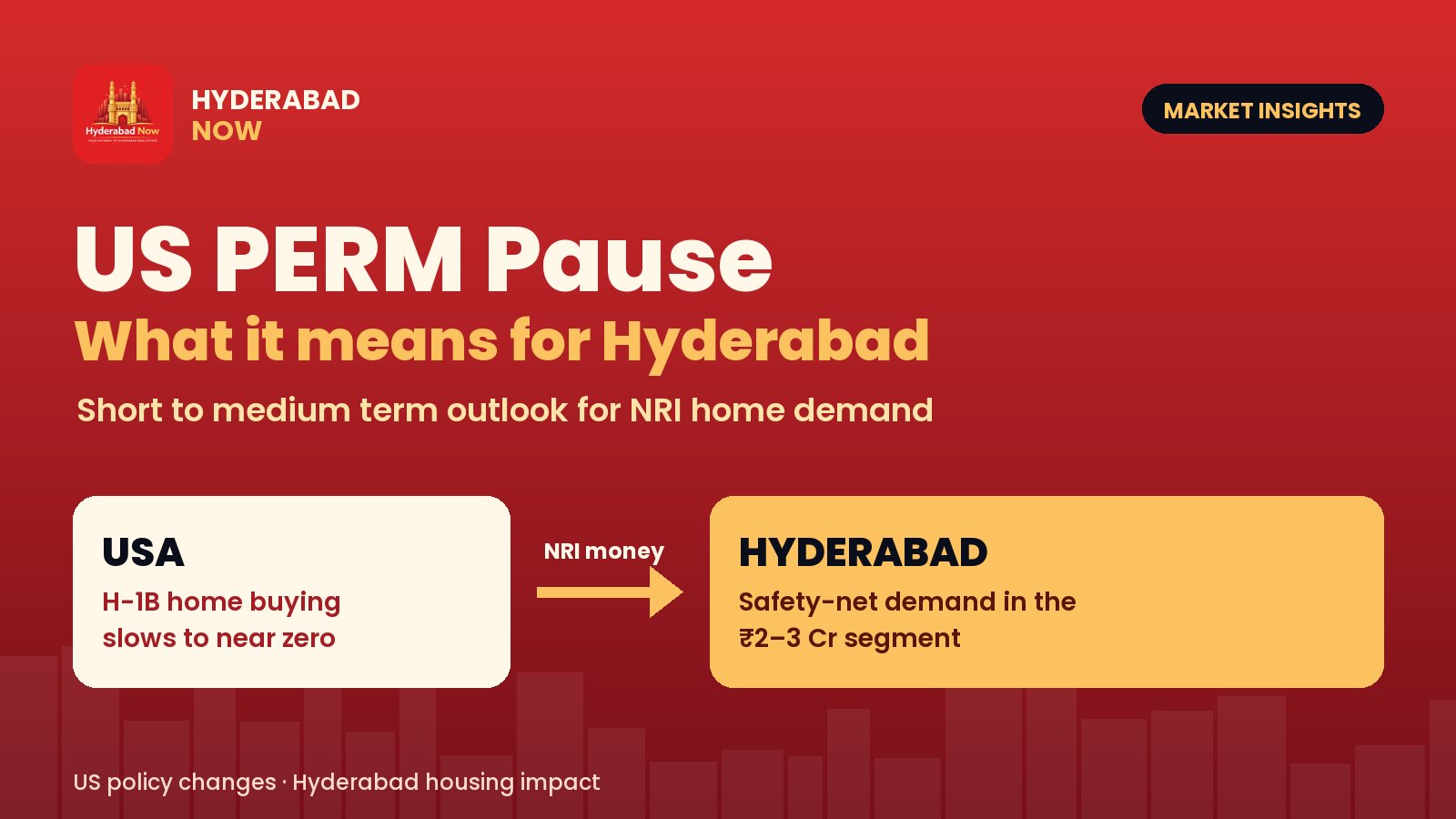
The US Department of Labor (DoL) has suspended PERM applications and processing for several major IT employers: Wipro, Infosys, TCS, Cognizant, HCL and Capgemini, along with Microsoft and Adobe. It's a big setback for Indian students and H-1B professionals hoping to settle in the US.
Thousands of those families have roots in Hyderabad, so the news matters here too. Here's what it could mean for the city's real estate market over the next year or two.
First, what is PERM?
PERM is the first major step in the US Green Card process. It also lets H-1B employees stay in the US beyond the usual 6-year H-1B limit. Without a PERM filing in progress, many H-1B holders have a clock running on how long they can stay.
Pausing PERM at some of the biggest employers of Indian tech talent puts a question mark over thousands of long-term plans.
This could be just the beginning
The official pause may be only part of the story. Expect some of these knock-on effects:
Voluntary pauses. Other companies may quietly stop PERM and Green Card applications, hiring and sponsorships, especially with AI-driven layoffs and headcount cuts continuing.
Blanket hiring rules. Some employers may stop hiring anyone without a Green Card altogether, fearing further policy changes.
More uncertainty. For a young H-1B professional, the path to permanent residency now looks longer and less predictable than it did a year ago.
The US housing picture has already changed
Between 2021 and 2025, H-1B families were active home buyers in the US, and Indian neighbourhoods saw strong demand. That has already slowed, because of:
higher interest rates
visa restrictions
tighter immigration rules
Add the PERM pause, and new US home purchases by H-1B NRIs could come close to zero in the short term. Few people buy a house in a country where they aren't sure they can stay.
When plans abroad become uncertain, the conversation turns to home.
The short to medium term impact on Hyderabad
1. More NRI money coming home
Money that would have gone into a US down payment needs somewhere to go. Some NRIs will start moving more savings back to India, and Hyderabad, with its IT-driven economy and strong NRI links, is a natural destination.
2. The "safety net" buyer
Uncertainty changes priorities. Many NRIs will start thinking about a home back in India as a safety net, somewhere to return to if their visa situation changes. That could drive steady, genuine demand rather than speculative buying.
3. The sweet spot: ₹2–3 Cr, not ₹5–6 Cr
This is the important part. We don't expect a sudden rush for ₹5–6 Cr villas or ultra-luxury apartments. Most of the new demand from young H-1B professionals is likely to sit in the ₹2–3 Cr segment, or slightly higher.
In practice, that means well-built 3BHKs in established gated communities around the IT corridor: places like Kondapur, Gachibowli, Nallagandla, Tellapur, Narsingi and Kokapet. These are homes that work as a family residence, a rental income source or both.
4. Remote buyers, higher expectations
NRI buyers often shop from 10,000 km away. They want verified listings, clear photos, honest pricing and direct contact with owners, not a chain of brokers they can't meet.
What about the long term?
That depends on how US immigration policy evolves. If restrictions ease, some of this demand may cool. If they tighten further, the trend of NRIs building a base in Hyderabad could strengthen over time.
What this means for you
If you're selling a ₹2–3 Cr home, this is a buyer pool worth reaching. Make your listing NRI-ready: good photos (here's how), a realistic price (check it first) and quick responses across time zones.
If you're an NRI exploring a safety-net home, focus on locality, community quality and rental potential, not just headline prices.
Either way, HyderabadNow connects buyers and sellers directly, with verified listings and zero brokerage.